/2025/10/02/1170592005.jpg)
Announcement for June 23, 2026 at 08:39 PM GMT
THIS IS AN ANNOUNCEMENT FOR THE MSCI GLOBAL STANDARD INDEXES RESULTS OF THE MSCI 2026 MARKET CLASSIFICATION REVIEW
MSCI released the results of the MSCI 2026 Market Classification Review.
Read Also: GLOBAL MARKETS-Stocks Hit by Fed Rate Reality Check; Oil Slips
Key takeaways from this year's review include:
* Reclassification of Bulgaria from Standalone to Frontier Market status
* Assessment of shareholder transparency and coordinated trading concerns in the Indonesian and Turkish equity markets, acknowledging the announced steps undertaken by both markets to address these matters and noting the continued potential for future consultations on the appropriate treatment of these markets if credible progress is not observed
* Acknowledgement of the removal of floor prices in Bangladesh, with a caution that any reintroduction could prompt a consultation on reclassification from Frontier to Standalone Market status
* Ongoing monitoring of the implementation of measures aimed at improving the accessibility of the Korean equity market for international institutional investors
* Reminder on the reclassification of Greece from Emerging to Developed Market status at the May 2027 Index Review
"The MSCI Market Classification Framework determines whether a market is developed, emerging, or frontier based on the accessibility and investability that international institutional investors actually experience," said Raman Aylur Subramanian, Head of Market Classification and Taxonomies. "Index inclusion and market classification are not static judgments. They must be continuously assessed against market changes and the experience of international institutional investors. When market access or experiences worsen, our framework requires us to respond decisively. And when market accessibility and investability improve in a meaningful and sustained way, markets can progress through the classification framework, as seen with Bulgaria and Greece."
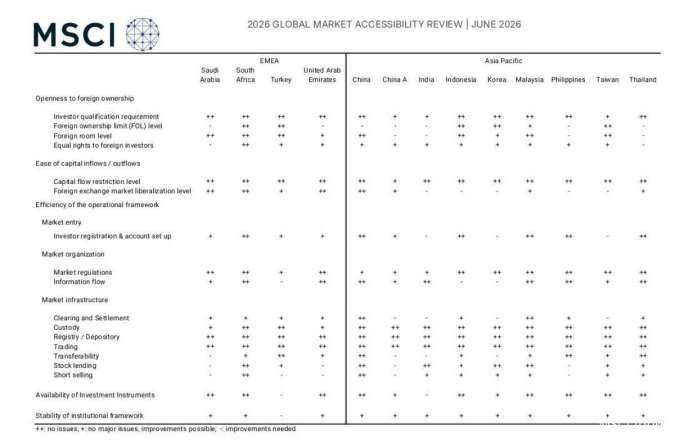
More information related to the MSCI 2026 Market Classification Review, including the results of the 2026 MSCI Global Market Accessibility Review, can be viewed at: www.msci.com/market-classification.
Read Also: Indonesia's Emerging Markets Crown On The Line as MSCI Verdict Looms
Results of the Consultation on the Classification of Bulgaria
MSCI announced its decision to reclassify Bulgaria from Standalone Market status to Frontier Market status. The reclassification proposal was originally launched for consultation in 2024, after enough Bulgarian securities met the Size and Liquidity Requirements for Frontier Markets. The decision was subsequently deferred following feedback from international institutional investors, who cited limited market liquidity and the timing of the euro adoption.
Since then, conditions have materially improved. Market participants agreed that liquidity on the Bulgarian Stock Exchange (BSE) has improved meaningfully, supported by a higher number of securities meeting the Frontier Market Size and Liquidity Requirements and rising turnover. No significant operational challenges were identified following Bulgaria's transition to the euro, which was completed on January 1, 2026, when BSE's trading and post-trading infrastructure transitioned fully to euro denomination. Bulgaria had previously migrated to the European Central Bank's TARGET2-Securities (T2S) platform in September 2023, and following euro adoption, all settlements now occur in euros.
The reclassification will be implemented in one step across all standard, custom and derived MSCI Indexes, coinciding with the May 2027 Index Review. MSCI will share additional details on the implementation process in due course.
The accessibility report for Bulgaria is now reflected in the MSCI 2026 Global Market Accessibility Review report available at https://www.msci.com/market-classification.
Read Also: Indonesia Plans to Embed AI in Key Programmes, Including $15 Billion Free-Meal Drive
Shareholder Transparency and Coordinated Trading Concerns
International institutional investors frequently raise concerns with MSCI when they experience persistent opacity in shareholding structures and suspect coordinated trading behavior. Both concerns materially limit investors' ability to assess true free float and to rely on observed market prices for portfolio construction and index replication, and they relate directly to the Information Flow and Market Infrastructure pillars of the MSCI Market Accessibility framework.
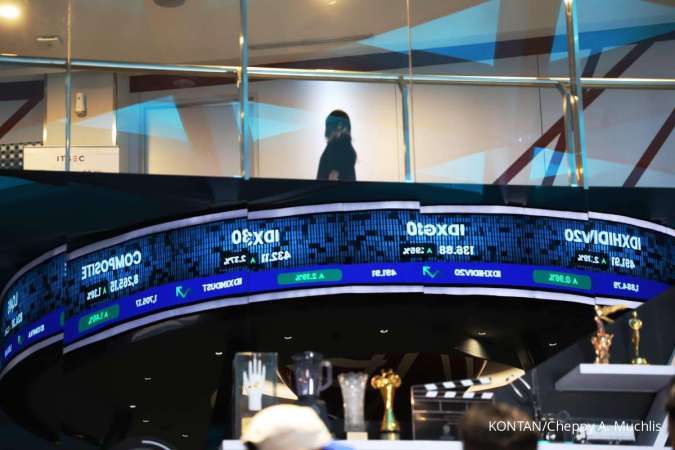
For Indonesia, market participants raised profound investability concerns stemming from these issues. MSCI acknowledges the recent transparency reforms announced by Otoritas Jasa Keuangan (OJK), PT Bursa Efek Indonesia (IDX), and PT Kustodian Sentral Efek Indonesia (KSEI), including enhanced disclosure of shareholders with ownership above 1%, more granular investor classification, the introduction of a High Shareholding Concentration (HSC) framework, and a roadmap to raise the minimum free float requirement to 15%. While these announcements represent a step in the right direction, what matters for international institutional investors is the consistent implementation and sustained effect of these measures across the market. MSCI will continue to assess their scope, consistency and sustained effectiveness in the context of free float determination and broader investability assessments. Should sufficient progress not be evident by the time of the November 2026 MSCI Index Review, MSCI will consider a range of options for the appropriate treatment for the Indonesia market, potentially including a consultation on the reclassification of Indonesia from Emerging Markets to Frontier Markets.
For Turkey, international institutional investors have highlighted recurring instances of possible coordinated trading behavior involving fund holdings closely affiliated with certain smaller, listed companies, with the effect of artificially inflating free float estimates. MSCI acknowledges the decision issued by the Capital Markets Board of Turkey (SPK), which recently introduced a framework for excluding fund-held stakes from the exchange's free float calculations where the underlying beneficial ownership belongs to parties already excluded from free float. Nevertheless, market participants want to see the impact of these adjusted calculations in practice. Additionally, international investors have communicated that they seek further progress, including granular and timely disclosure of beneficial ownership, robust surveillance and enforcement against coordinated trading behavior, and a transparent, rules-based framework for the identification and treatment of securities exhibiting structurally distorted free float. If sufficient tangible and credible progress is not evident in the Turkey market by the time of the November 2026 MSCI Index Review, MSCI may launch a consultation on the appropriate treatment for Turkey and its eligible securities.
MSCI continues to welcome feedback on shareholder transparency and trading behavior in these markets.
Read Also: EMERGING MARKETS-Indonesian Rupiah, Stocks Fall as MSCI Investability Concerns Weigh
Removal of Floor Prices in Bangladesh
Floor prices have now been removed from all affected securities in the Bangladesh equity market. MSCI welcomes this development. Floor prices severely hinder a market's accessibility, distorting price discovery and impairing the ability of international institutional investors to enter and exit positions at fair value, and their removal is an important step toward restoring the investability of the market.
MSCI cautions that the reintroduction of floor prices on any listed securities would once again severely impair the accessibility of the Bangladesh equity market. Should floor prices be reimposed, MSCI may launch a consultation on a potential reclassification of Bangladesh from Frontier Market status to Standalone Market status. MSCI continues to welcome feedback on the accessibility of the Bangladesh equity market.
Market Accessibility of Korea
From 2008 to 2014, MSCI consulted with global market participants on the potential reclassification of Korea from Emerging Market status to Developed Market status. Market participants identified the limited convertibility of the Korean won in the offshore currency market as a key barrier to reclassification. Other accessibility issues highlighted at the time included the rigidity of the investor ID system, the restrictions on in-kind transfers and off-exchange transactions, and the limited availability of investment instruments stemming from restrictions on the use of exchange data for the creation of financial products.
MSCI acknowledges the measures announced by Korean market authorities to address these long-standing concerns. However, investors have communicated that the underlying issues have not been fully resolved. The Korean won is not deliverable offshore. Even more concerning, onshore liquidity during the extended FX trading hours remains largely insufficient to support tight execution at standards comparable to those observed in developed markets, constraining FX operational flexibility for index replicators and others. International institutional investors will need to be convinced that this trading of the won in overnight markets in Korea will eventually provide large, deep and consistent pools of liquidity and tight bid/ask spreads that are comparable to day trading hours for other developed market currencies in the world. Operational adoption of omnibus accounts and in-kind transfers remains limited. Following the lifting of the short-selling ban, market participants continue to face significant operational burdens under the reinstated compliance regime. In addition, early pre-settlement funding requirements remain a burden for market participants.
MSCI will continue to monitor implementation and engage with market participants and Korean authorities. As a reminder, potential reclassification consultations require that all issues have been addressed, reforms have been fully implemented, and market participants have had ample time to thoroughly evaluate the sustained effectiveness of the changes.
Market Classification of Greece
On March 31, 2026, MSCI announced its decision to reclassify Greece from Emerging Market status to Developed Market status, following a consultation launched on January 26, 2026. The majority of consultation participants favored the proposed reclassification, recognizing that Greece's market infrastructure has converged with Developed European standards and meets the criteria for MSCI Developed Markets.
The reclassification will be implemented in one step across all standard, custom and derived MSCI Indexes, coinciding with the May 2027 Index Review. Once reclassified, Greece will be incorporated into the Developed Europe single market index construction process, and existing constituent rules will be applied to minimize turnover at the time of the reclassification.